8 Best Things To Buy In Khan El Khalili (A Local’s Guide)
Khan el Khalili is a historic open-air souq packed with medieval mosques, lively cafes and mazes of colorful shops.
It’s an absolute must on your Cairo itinerary to soak in some local atmosphere and browse local handicrafts.
But Khan el Khalili is also notorious for aggressive vendors. And if you can believe it: about 60% of all items at this souq are not even made in Egypt.
That means if you’re looking for handcrafted souvenirs, you’ll have to dig through plenty of Chinese dupes and plastic pyramids.


So what are the best things to buy in Khan el Khalili?
And how can you plan your visit to avoid the hassles – and find the best treasures?
I’m a travel planner living for over a decade in Egypt and I’ve been shopping at Khan el Khalili for years.
And this is my ultimate guide to shopping in Khan el Khalili – including all the must-haves, insider tips and what to avoid.
Best things to buy in Khan el Khalili:
1. Metal lamps and lanterns

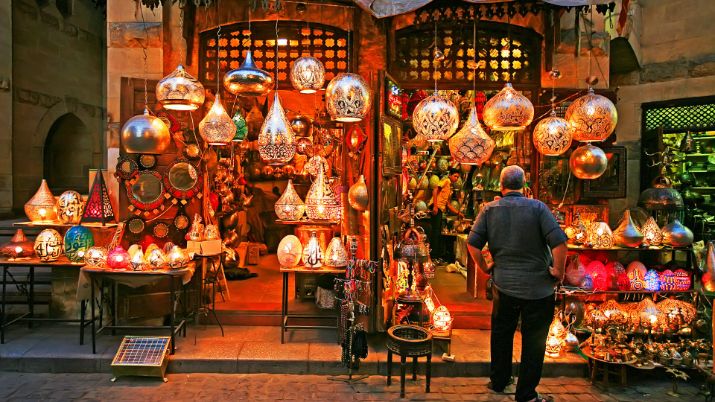
Head to the historic gate Bab al-Ghuri for an array of shops that sell colorful metal lamps decorated with intricate carvings and colored glass.
Bab al-Ghuri is especially magical at night when hundreds of the lamps are lit and the intricate metalwork casts patters on the walls.
These metal lamps range from enormous round chandeliers decorated with Arabic calligraphy that are powered with lightbulbs to small, square candleholders.
There are also electric egg-shaped lanters – especially popular during Ramadan – made with a mosaic of colorful glass pieces.

Egypt’s famous Ramadan lanterns, or fanoos, were invented in Fatimid-era Egypt (10th to 12th centuries). They illuminated the streets during the holy month when the faithful walked to mosques for late-night prayers.
Metal lamps are very durable and pack easily. You can find many of them at Bab al-Ghuri but also scattered around smaller shops all through Khan el Khalili.
2. Wooden boxes with mother of pearl

Khan el Khalili has many wooden boxes inlaid with mother of pearl that make beautiful handmade souvenirs.
These elegant boxes range in shape and dimension from pocket-sized to coffee-table large. They’re made with either mother of pearl or cheaper materials like conch seashells and plastic.
Inlay work has a long tradition in regional art and furniture. Ancient Egyptians used the technique to adorn wooden shrines and mummy covers.

Mother of pearl boxes are made in a painstaking process. The artisan first cuts the beech wood and nails it together. The box is then decorated with white resin and hundreds of mother of pearl pieces. It’s later smoothed down with sandpaper and lined inside with velvet.
3. Ancient Egyptian figurines

You’ll find rows of Ancient Egyptian figurines, pyramids, ankhs and scarabs piled high at Khan el Khalili at an array of shops.
Quality ranges from masterful replicas that could easily pass for the real thing – to cheap and sloppily made figurines with creepy and disproportionate features. Browse a few shops and you’ll easily find some quality pieces.
A small colorful scarab or an ancient Egyptian goddess carved from stone makes a beautiful souvenir.

You’ll find these figurines all throughout Egypt’s tourist souqs, especially in Luxor where the alabaster is especially fine.
These statues range from proud figures of feline goddess Bastet and Nefertiti to the canopic jars the ancients used to store mummy innards.
The statues can be made of anything from alabaster and heavy stone to cheap, painted plastic. It’s easy to tell the difference by the weight and feel of the statue.
4. Personalized notebooks


This beautiful gem of a bookshop is tucked away on a side street behind Cairo’s iconic Al Azhar Mosque.
It’s just across the street from Khan el Khalili – and not far from the Khayamiya tent maker’s market.
Abd El-Zaher offers personalized leather-bound notebooks, bargain-priced notepads, photo albums with old-fashioned mounting corners, sketchbooks, vintage postcards and a small selection of books.
The workers can stamp your name (in Arabic or English) into any notebook you choose – on the spot while you wait.
You can watch the craftsmen at work on the lettering too.

If you have old books that are falling apart, Abd El-Zaher can rebind them for you. Though rebinding means leaving your book there for approximately 10 days.
The Abd El-Zaher Bookstore is more than 80 years old and it’s home to three generations of craftsmen who keep the rare art of book binding alive.
Shopping at this small and cozy boutique is an experience.
And what better way to record your Egyptian vacation than in a personalized travel journal?
5. Spices

You’ll find lots of spice shops scattered around Khan el Khalili and vendors with colorful displays of spices.
But are the spices of Khan el Khalili really worth buying? They’re not necessarily better quality than what you’d find at your local Middle Eastern grocer. Though there are exceptions.
There are some spices that are worth buying – and taste better than those you’ll find at home.
- Egyptian cumin is well worth getting. It’s delicious and tasty, and has a history dating back to the New Kingdom of Ancient Egypt. It was once used as a preservative in mummification. And today it’s a common everyday spice found in all Egyptian kitchens.
- Hibiscus (pictured above) is also worth buying. It makes a refreshing drink in the summer, and it’s great for blood pressure too. You’ll find dried hibiscus flowers at many Khan el Khalil vendors. And hibiscus is easy to make at home: just boil the leaves in water and add sugar to taste.
6. Khayamiya cushions


Handmade khayamiya cushions are some of the most vibrant Egyptian souvenirs with a long history.
They feature nature motifs like colorful birds and papyrus, geometric patterns, Ancient Egyptian themes and Egyptian folk art like dancing dervishes and Arabic calligraphy.
Khayamiya cushions add lots of color and personality to a room. And they pack really well: they’re light and don’t take up much space in your suitcase.

Khayamiya range from square cushion covers to enormous and elaborate wall hangings.
You’ll also find select pieces of Khayamiya scattered around different shops in Khan el Khalili.
For the best selection, head to the Tentmakers Market (pictured above) on Moez Street – it’s about a 15-minute walk from Khan el Khalili itself. This market has an entire row of different workshops where local artisans stitch their pieces.
There are also cheap dupes of khayamiya that are factory-printed patterns on textile. You can spot these easily because they don’t have the visible hand stitching.
7. Incense burners

Incense and oud burners are some of my favorite souvenirs from Khan el Khalili – they really pack an intense, gorgeous scent.
The region has a tradition of frankincense. And burning oud is a weekly routine for many Egyptians (especially on Fridays).
It’s a completely different process from your standard stick incense.
Burning oud fills up your entire home with a rich, woody fragrance that also permeates your clothes and lasts for days.

I love my oud burner. I learned how to use it from YouTube and I really wish I’d known about it sooner.
There are many burners to chose from across Khan el Khalili. They range from basic lantern-shaped burners to colorful alabaster burners with ornate metal lids.
You’ll need to get a 1) burner, 2) some charcoal and then 3) frankincense, oud or oud chips to get going.
8. Alabaster vases

Khan el Khalili has beautiful alabaster vases with natural veins and patterns.
Found abundantly in Luxor and Aswan, alabaster makes unique pieces that you’ll love to have on your table.
Alabaster vases are sold throughout Khan el Khalili. There are a few good shops around Hussein Mosque and it’s always better to visit a few shops before you make a selection.
How to get to Khan el Khalili

Take an Uber to Azhar Mosque (a place most drivers easily recognize) and the bazaar is just across the street. There’s an underground passageway for pedestrians.
I always leave also from Azhar Mosque because the spot is easy to find for drivers and has plenty of space for a taxi to pull over (no getting lost in narrow alleys).
Khan el Khalili is pedestrian only so your taxi cannot drop you off inside the souq itself (which is all narrow streets with no cars.)
When to visit Khan el Khalili


Most shops open around 9 am until midnight.
Friday mornings are quiet with most shops closed for weekly prayers. Sunday is also slow, though plenty of vendors stay open.
Most shops stay open during Ramadan though you might find a single salesperson in charge of a few different shops.
Weekends and nights are crowded.
Summers are hot so pack lots of iced water – and don’t forget your hat and sunscreen.
Khan el Khalili: an ultimate guide

Moez Street itinerary

Moez is a kilometer-long street in Islamic Cairo (right alongside Khan el Khalili) that’s lined with treasures of medieval architecture – from splendid mosques to historic homes and palaces.

